

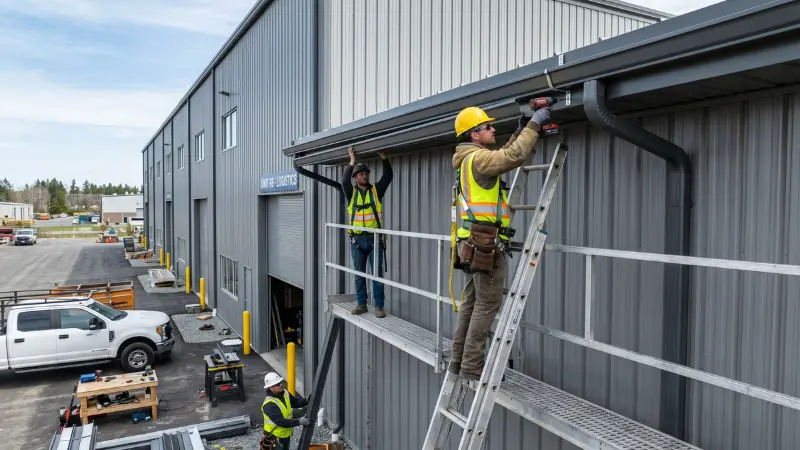
Uncontrolled rainwater can accelerate a building’s deterioration more than most owners expect. It stains walls, weakens roof edges, floods entrances, and puts pressure on the foundation.
That is why commercial gutter installation is more than a finishing detail. A well-built system moves water away from the roof, walls, and base of the structure, protecting the building envelope and helping the property last longer. That matters even more in large facilities, where one weak drainage path can affect several building systems at once.
When the system is sized and placed correctly, it reduces pressure on the building envelope from the roof edge down to the foundation and is a key part in maintaining a commercial facility.
Without a clear path, water falls straight off the roof edge or backs up at low points. Then it pools near the building, washes out soil, and can settle against the foundation. Over time, that moisture can stain masonry, rot fascia, and damage soffits or roof edges.
Problems also show up inside. Water can slip behind cladding, find gaps near wall joints, and trigger leaks that look small at first. Later, those leaks can lead to mold, ceiling damage, and repairs that reach far beyond the gutter line. Entrances, sidewalks, and loading areas also take a hit when runoff creates erosion or slick surfaces.
A commercial roof can shed a huge volume of water in a short storm. Low-slope roofs also drain differently from steep residential roofs, and runoff often concentrates in fewer discharge points. That means the gutter system has to handle more load, more force, and longer flow paths.
Building use matters too. A retail center, warehouse, and office building won’t drain the same way. Roof size, parapets, canopies, and traffic at grade all change the design. Because of that, commercial work needs a system matched to the building design.
Long service life starts with the basic parts of the system. If those parts are selected well, the gutters stay straighter, drain faster, and need fewer repairs.
Size controls capacity. If the gutter is too small, it overflows during heavy rain. If downspouts are too few or placed poorly, water backs up and adds weight to the run. That can lead to sagging joints, standing water, and leaks at seams.
Slope matters just as much. A gutter does not need a dramatic pitch, but it does need enough fall to move water toward outlets.
The right material depends on climate, roof size, and long-term maintenance expectations. Common options include:
Freeze-thaw cycles, coastal air, and industrial exposure all affect how fast a material wears. Long-term value is about fit, not just first cost.
Small parts often decide whether the system stays tight over time:
Good materials can’t fix poor layout or rushed workmanship. In commercial work, installation quality has a direct effect on service life and repair costs.
Before installation begins, the team should map the roof shape, outlet locations, overflow points, and grade conditions below. That plan tells the installer where water will travel during normal rain and where it will go in a storm. Without that step, the system may look fine on day one and still perform badly.
That planning also protects adjacent work. Roof membranes, edge metal, canopies, and splash areas all need to line up with the drainage path. A missed detail at the edge can turn into a recurring overflow.
Gutters do not work alone. They connect to roofing, fascia, wall assemblies, and drainage at grade. If those parts do not work together, water can get trapped where it should be moving away.
On larger jobs, this is where experienced construction teams stand out. Field crews who understand carpentry details, concrete and site drainage, and roof edge conditions can catch conflicts early. Strong coordination with trusted subcontractors also helps, because commercial drainage often crosses trade lines.
Commercial gutter installation isn’t just a construction task; it’s part of a building’s regulated stormwater management system. In most jurisdictions, that means permits and code compliance are part of the job, not optional extras.
The two primary frameworks governing commercial drainage are the International Building Code (IBC), specifically Section 1503 on roof drainage, and the SMACNA Architectural Sheet Metal Manual, which provides guidance on sizing and fabrication standards. Together, they set the baseline for how commercial systems must be designed and installed.
A few compliance points worth knowing:
A qualified commercial contractor will tell you upfront what the permitting requirements are for your specific project and jurisdiction.
Even a well-installed system needs routine care. The good news is that most maintenance is simple and low-cost when it happens on time.
Facility teams should check gutters after heavy rain, wind, or seasonal leaf drop. During each inspection, look for:
Repair is the right call when the issue is local, and the overall design is sound:
Replace when the problem points to a systemic issue:
A strong commercial gutter installation does more than move rainwater. It protects the roof edge, walls, foundation, and the daily use of the property. The best results come from proper sizing, durable materials, solid installation, and steady maintenance.
Moltus Building Group knows how to ensure those pieces work together to prevent water-related wear, keep repair costs minimal, and ensure the property has a better chance to perform well for years. Contact the Moltus team today if you are looking for a trusted partner in commercial facility maintenance and gutter installation.
Partner with Moltus Building Group for commercial and industrial facility maintenance services backed by experienced management, modern solutions, and reliable project delivery. We help maintain operational efficiency, safety and compliance, improved appearances, and cost savings.